
From vision to real transformation of Europe's fashion and textile industry

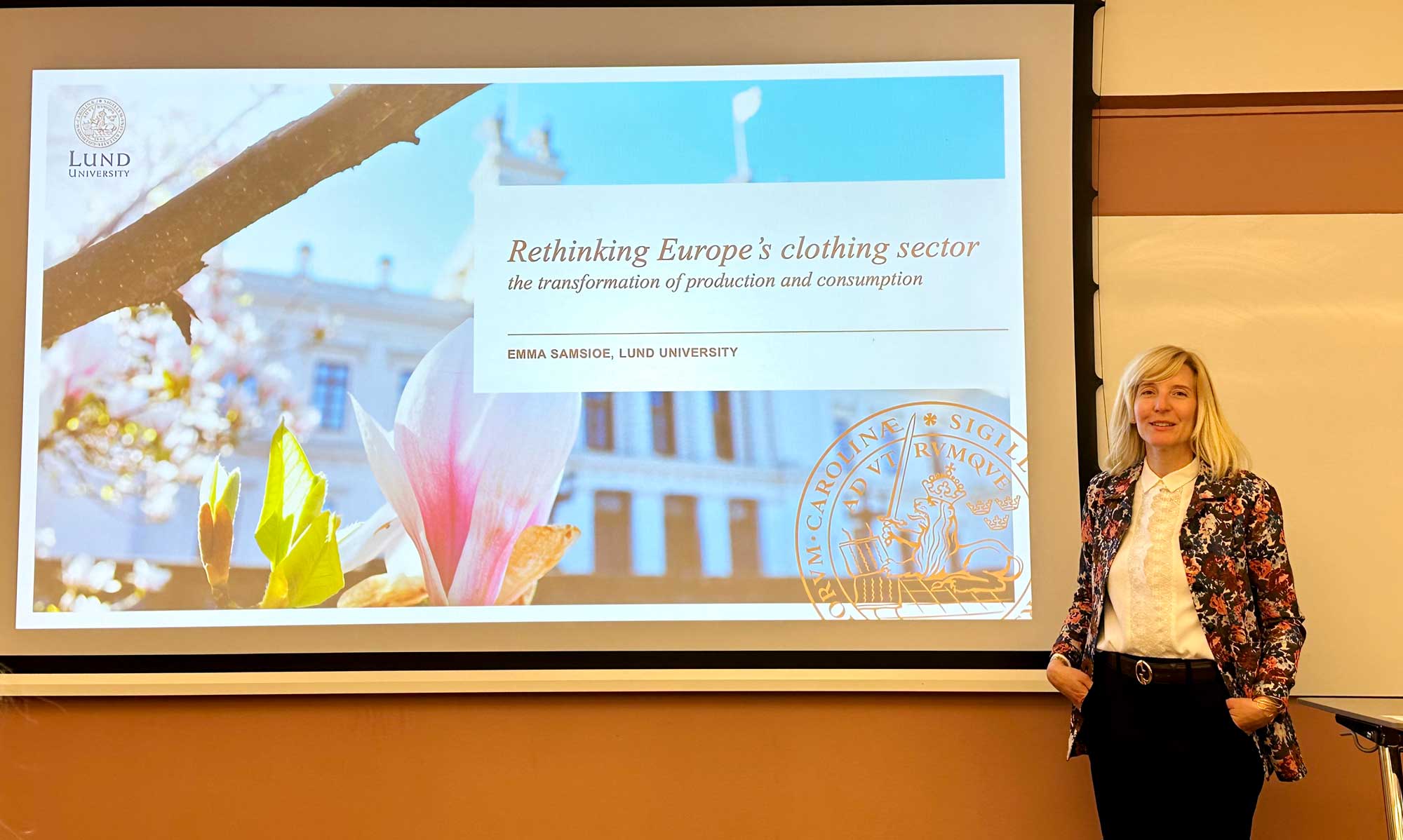
Moderator Emma Samsioe began by highlighting the challenges and opportunities in the textile industry in Europe. It is about overconsumption and overproduction of clothes, but also about EU rules and directives: Extended producer responsibility (EPR), digital product passport (DPP) and a ban on greenwashing and on producers who destroy unsold clothes. At the same time, organizations are working to increase sustainability through new business models, new and more sustainable design and new sustainable consumption patterns.
Mariangela Lavanga and Young Kim, both from Erasmus University Rotterdam (The Netherlands), talked about how the role of place in advancing circularity in the fashion and textile industry, and why cities need to move from being mere consumption spaces to productive ones. In particular, they have mapped different clusters in the fashion and textile industry in the Netherlands as part of the Horizon Europe project FABRIX - Fostering local, beautiful, and sustainably designed regenerative textile and clothing ecosystems - that is about rethinking the relationships between the fashion industry and cities and how to redistribute the local players in the fashion chain to create stronger ecosystems for circularity.
Lavanga and Kim have investigated where different players in the textile and fashion value chain are established in order to find patterns in different geographical areas, but also to compare the area with the national picture and see trends over time. By knowing where different initiatives are located, it is possible to improve local supply chains and ecosystems by complementing with what the ecosystem needs, such as facilitators.
Charlotte Lorentz Hjorth presented the work within ekip, which is a European policy platform designed to strengthen the development of innovation capacity in ecosystems, with a special focus on the Cultural and Creative Industries (CCI). The work started in 2023 and partners from all over Europe are developing policy recommendations on behalf of the European Commission to promote innovation in CCI. "Among other things, we need to change how ecosystems support this sector. One way is to develop how to support partnerships between several groups or "swarms" of companies instead of focusing on "unicorns", said Charlotte Lorentz Hjorth, who is the consortium leader for ekip. In ekip, we are working to develop recommendations for how the so-called building blocks that an innovation ecosystem contains can be developed. Read more about ekip and about ”the swarm”.
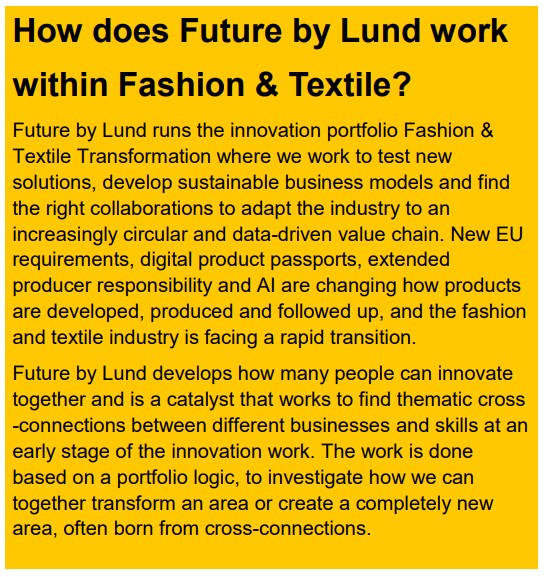
Another central issue during the symposium was transparency – and how it can be achieved. Lars Mattiasson from Future by Lund highlighted Digital Product Passports (DPP) as a tool to make visible the entire life cycle of products and thus create opportunities for increased sustainability. With the help of digital product passports, information about materials, production and environmental impact can be made available to both companies and consumers. Read more here. An important element of this is to make the industry see that DPP is not static information but something that changes – and that the information that is present at different stages of a product's journey can be available differently depending on which player you are.
Sustainability and fairness in the fashion industry are at the heart of Mariko Takedomi Karlsson's ongoing project Breaking with business as usual at Lund University. The project examines the Swedish fashion industry with production in Bangladesh. Environmental degradation and unsustainable working conditions are the fashion industry's worst consequences, and in this work, the conditions of the workers in Bangladesh are investigated and at the same time have a collaboration with Swedish companies that work with factories in the same country. An ambition to put a human perspective on the climate transition. The project will, among other things, result in a handbook for a just transition in the fashion industry with tools and methods for companies to achieve the goals, but workshops will also be held with Swedish fashion companies. The project is carried out in collaboration with Fair Action and Swedwatch, and is funded by Formas. Link to Lund University's Research Portal
Ingrid Haugsrud from Oslo Metropolitan University and Reka Tölg, Lund University, presented the CARE project which examined clothing consumption in a hundred European households. The CARE project is primarily about changing consumers' practices, i.e. the everyday habits, routines and actions that govern how people buy, use and dispose of goods and services. This can be done by looking at how to get consumers to see their wardrobe as sufficient, but also by increasing competence in how to care for their clothes and increasing interest in reusing clothes. In this way, sustainable consumption can be integrated into people's everyday lives. Read more.
The role of the consumer was at the centre of researcher Katherine Duffy's study of the SYW app. Research shows that digital tools can affect how people relate to their clothes – how often they are used, how they are valued and how long they are kept. By making use visible and creating new patterns of behavior, apps like SYW can contribute to more sustainable consumption practices. Read more here. Duffy, Katherine , Shaw, Deirdre and Kourda, Hasna (2026) Accelerating change to decelerate consumption: customer value propositions for a sustainability start-up. European Journal of Marketing, 60(4), pp. 1028-1039. (doi: 10.1108/EJM-04-2024-0315) Read more.
The Closet is a startup from Lund that is a local initiative to create greater interest in lending and renting clothes. The Fashioning AI project explores how artificial intelligence affects the fashion industry and its design processes. The researchers Despina Christoforidou och Magdalena Petersson McIntyre see that AI can be assumed to reinforce prevailing ideals and that often the choice of appearance of the human models makes it less inclusive. Read more here!
The symposium Rethinking Europe's clothing sector was organized by Emma Samsioe at the Department of Service Studies with funding from the Centre for European Studies at Lund University, in collaboration with three Horizon Europe-funded projects (CARE, FABRIX and ekip) and startups.