
E.ON's innovation seeks energy balance

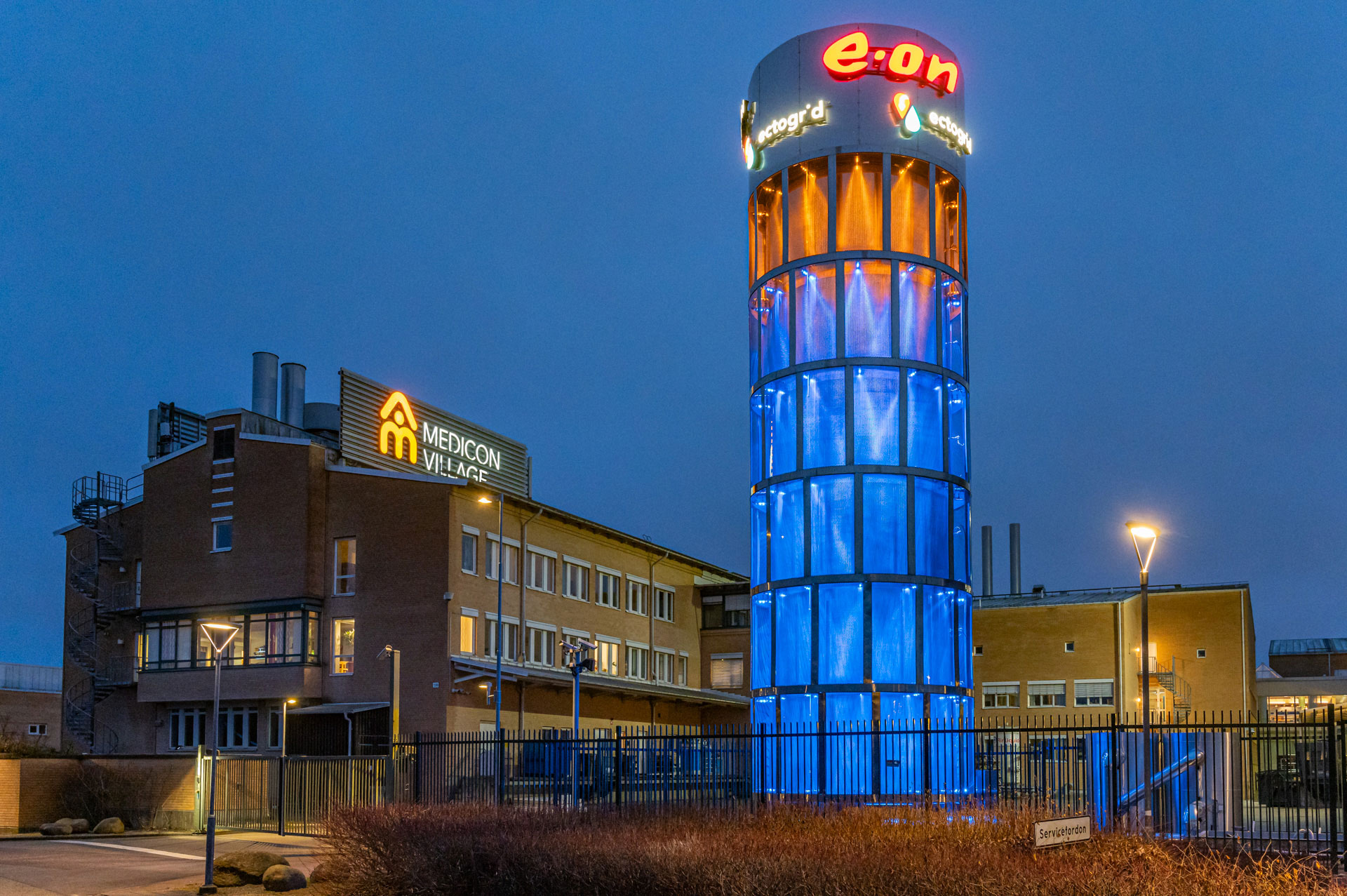
Image: Medicon Village/E.ON
Approximately ten years ago, in the Future Living project run by Future by Lund, E.ON, with its patented energy innovation E.ON ectogrid™, and Medicon Village, with properties suitable for the energy system. This is why the world's first ectogrid™ is located in Lund, and Medicon Village serves as E.ON's global innovation and demonstration platform for the system.
- Future by Lund's network laid the groundwork for the collaboration with Medicon Village, says Mattias Örtenvik, Head of Sustainable City Development, E.ON. Following this, a project was undertaken, among other things, concerning how the next generation of district heating systems can interact with urban planning. Future by Lund also facilitated some contacts with several European cities.
As the facility at Medicon Village is a demonstration site, visitors come every week to see it in operation. Guests are often real estate companies and investors, but also decision-makers, including a British minister.
- Medicon Village is our main showcase, and getting them to Lund can be absolutely crucial for the sales process, says Niklas Johansson, who has been responsible for expanding ectogrid™ in Europe for the past two years.
Now, some newer and larger projects are underway. In London, the first two buildings were connected in the Silvertown district in the heart of London. Silvertown is an old industrial area with London City Airport nearby. The area is now being redeveloped, and 6,500 homes are to be built.
- Silvertown in London is a special case for us because residents in the UK are accustomed to having their own unit in the form of a gas boiler in their apartment, Niklas Johansson continues. Normally, we would have a shared production unit, for example, in the basement of the property to distribute heating and cooling. In Silvertown, all apartments will have their own heat pump. Each apartment also has approximately 100 measuring points that interact in a network to provide balanced energy.
The fact that each apartment has its own unit will drive the development of the ectocloud™ software. The measuring points provide a lot of data, allowing E.ON to predict energy supply and prevent maintenance issues. Furthermore, customer service can see how the system is functioning in real-time. In this particular area, windows cannot be opened due to noise, so it's important that the system also provides cooling in the residences.
Milan has its innovation district MIND, which is being built on the old exhibition grounds, and an ectogrid™ system has now begun to be installed there.
- What's most exciting about this area is that it's a 1 million square meter site. To begin with, we have connected two buildings to ectogrid™, and a balance tank has been lifted into the parking garage. Over time, we will connect more and more properties, such as E.ON's Italian headquarters, which will move to the area.
It takes a long time to develop new large areas. In both Milan and London, this involves a period of approximately ten years.
- Milan and Silvertown will be signature projects demonstrating that we can work with everything from smaller areas and medium-sized projects, such as Medicon Village, to entire city districts, says Niklas Johansson.
In addition to the two major projects, ectogrid™ systems are also being installed, for example, in Reims outside Paris and Sugar Valley in Munich. Furthermore, about ten discussions are underway regarding other projects. E.ON also has several medium-sized ectogrid™ projects already in progress. These include, for instance, E.ON's office in Szczecin, Poland, and a small district heating network in Gelsenkirchen, Germany.
Fundamentally, E.ON works with three types of projects. Firstly, there are areas like Medicon Village with a mix of offices, labs, and residences that are balanced against each other. Silvertown in London is another variant where residences are combined with waste heat sources from industry, in this case, a data center and a sugar factory. Finally, there are also areas with good geothermal conditions, such as Reims outside Paris, where mixed-use blocks are to be built.
At the UN climate conference COP28 in Dubai, E.ON ectogrid™ won the energy efficiency category. COP28 Energy Transition Changemakers is an initiative to promote scalable and innovative projects in the energy transition.
How does E.ON ectogrid™ work?
Here's how E.ON explains its system:
E.ON ectogrid™ produces both heating and cooling within a single system. Additionally, energy is balanced between buildings with varying heating and cooling needs before new energy is supplied.
E.ON ectogrid™ is a closed, low-temperature network where heat pumps and chillers in each building adjust the temperature as needed. In this process, each building then transfers excess heat or cooling to other buildings, depending on their requirements. By sharing, balancing, and storing energy in a closed loop, E.ON ectogrid™ efficiently utilizes all available energy flows before new energy is supplied. This drastically reduces energy consumption – and in turn, costs and environmental impact.
By primarily maximizing the use of all available energy within the system, E.ON ectogrid™ can delay bringing in new energy until the opportune moments. This helps relieve the strain on the electricity grid and provides greater opportunities to utilize intermittent renewable energy sources.
Cloud technology E.ON ectocloud™ uses algorithms to optimize energy flow and storage in E.ON ectogrid™ based on data including seasons, weather, local energy production, and energy prices.
(The text above is borrowed from E.ON's website)